

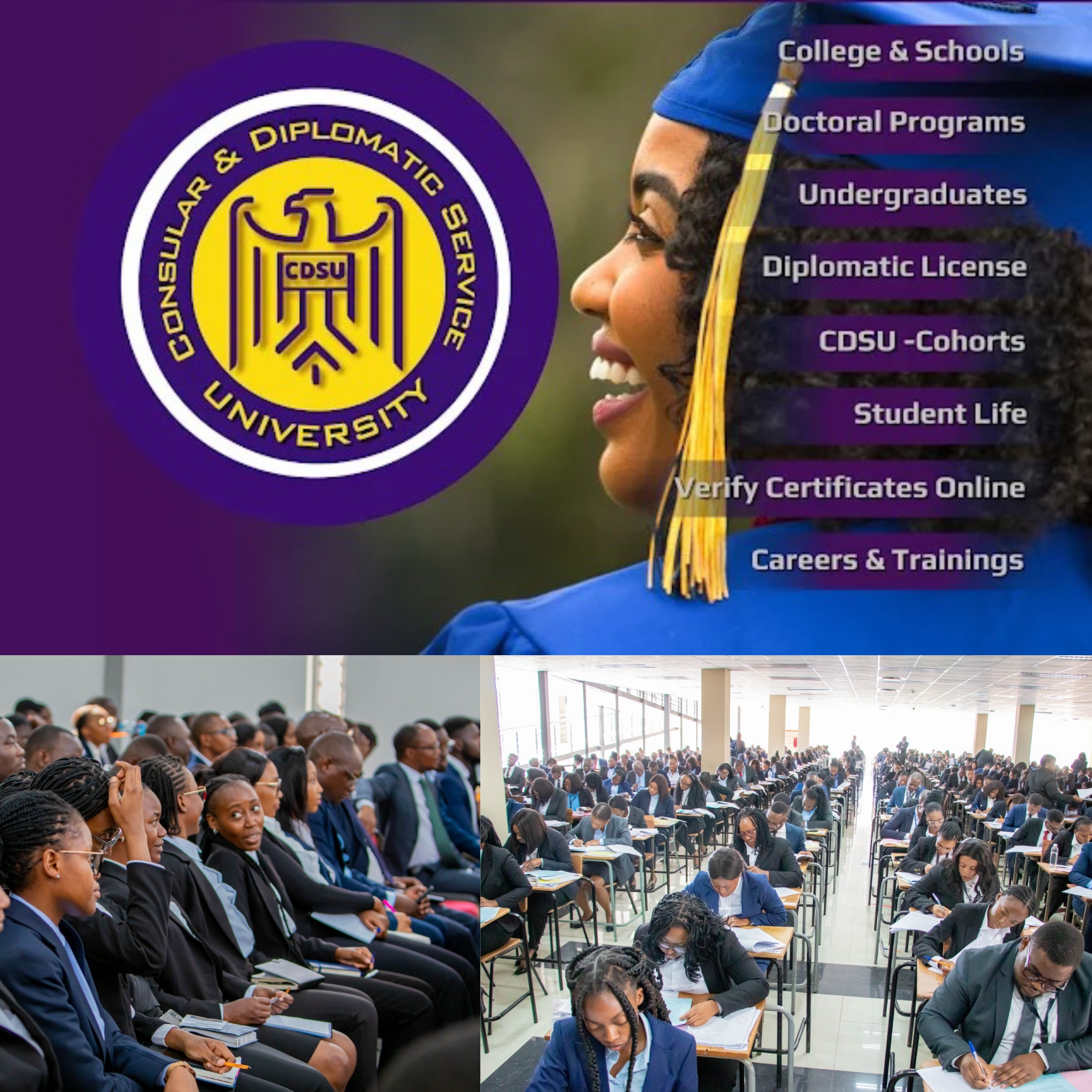
Since its establishment in 2015, the Consular & Diplomatic Service University (CDSU) has evolved into a leading platform for modern diplomatic education and professional formation across the African continent. Through a steadily expanding academic footprint, the institution has contributed to reshaping diplomatic training standards while strengthening the pipeline of emerging practitioners.
CDSU now enters a new institutional era defined by deeper continental alignment and renewed strategic ambition.
The university’s foundations trace to its origins as the Foreign Service Training Academy, conceived to address a growing need for structured, practice, oriented diplomatic capacity building. From the outset, its development was supported through collaboration with Ghanaian governmental and educational institutions, including early operations associated with the former U.S.
Embassy site in Osu. Additional institutional grounding was reinforced through linkages with the Kofi Annan International Peacekeeping Training Centre and Ghana’s Ministry of Foreign Affairs and Regional Integration. Academic partnership with the University of Ghana at Legon further strengthened curriculum credibility and professional relevance.
Collectively, these relationships established a durable framework for training that aligned public service discipline with international diplomatic standards. CDSU’s institutional direction has been shaped by successive vice-chancellorships that consolidated its governance and expanded its continental reach. The first vice-chancellor, H.E. Dr. Emily Milla-Amekor, a Ghanaian Standards Authority Scientific Officer, guided the university through early administrative consolidation and the initial expansion of regional programmes.
Her leadership was undertaken under a World Diplomatic Organization (WDO) appointment from London, reflecting the institution’s early integration into a broader diplomatic network. The current vice-chancellor, H.E. Amb. Sombo Ngenjo, a Zambian diplomat and Second Secretary, has advanced a renewed phase of continental integration and strategic positioning. Serving simultaneously as WDO Resident Diplomat and Country Representative for Zambia, he has reinforced CDSU’s role as a convening academic institution for cross-regional diplomatic engagement.
In 2017, the institution transitioned from the Emerging Leaders & Diplomats Institute into the Consular & Diplomatic Service University, marking a formal elevation of its academic mandate and institutional identity. It was subsequently designated a Diplomatic University through a treaty ratified by 54 African states, affirming its continental legitimacy and public-facing mission. Positioned within the AUYA framework prior to its reorganization under the African Diplomatic Organization, CDSU has been established as a pioneering, youth-centered diplomatic institution. This recognition has strengthened its standing as a structured pathway for professional diplomatic formation aligned with continental priorities.
CDSU functions as the official training institution for the seven-body WDO system, serving as its academic arm for professional development and institutional capacity building. This system comprises the World Diplomatic Organization, African Diplomatic Organization, Asian Diplomatic Organization, European Diplomatic Organization, American Diplomatic Organization, Middle-East Diplomatic Organization, and Oceania Diplomatic Organization. Through this mandate, the university delivers structured training programmes designed to meet evolving diplomatic, consular, and international service requirements. Its instructional reach extends across multiple continents, reinforcing a shared professional standard while remaining responsive to regional contexts and institutional needs.
The university’s academic vision has been guided by distinguished international figures whose counsel and stature have reinforced its credibility and purpose. Among these was the late H.E. Dr. Kofi Atta Annan, former United Nations Secretary-General, who served as the institution’s Patron and provided enduring symbolic and strategic inspiration. The influence of such leadership continues to shape CDSU’s commitment to principled diplomacy, rigorous training, and continental service through education.
The university’s academic vision has been guided by distinguished international figures whose counsel and stature have reinforced its credibility and purpose. Among these was the late H.E. Dr. Kofi Atta Annan, former United Nations Secretary-General, who served as the institution’s Patron and provided enduring symbolic and strategic inspiration. During the institution’s formative years, former Ghanaian President Jerry John Rawlings served as Chancellor, lending national stature to the university’s early consolidation and public-facing mission. CDSU also benefited from the academic guidance of Professor Jeffrey David Sachs, the global development economist whose engagement supported international partnerships and strengthened the institution’s outward-looking orientation.
Early programmes further featured participation from former President John Agyekum Kufuor and President Nana Addo Dankwa Akufo-Addo, underscoring the university’s convening role at the intersection of leadership, public service, and diplomatic formation.
CDSU’s origins were shaped by the policy momentum created by United Nations Security Council Resolution 2250, which elevated youth participation as a strategic pillar of peacebuilding and conflict prevention. This early framing informed the institution’s emphasis on youth, centered diplomatic formation and practical leadership development for public service.
An initial affiliation with the United Nations University further strengthened academic credibility, reinforcing alignment with international standards and a global outlook in programme design. As its mandate expanded, the university established academic branches in Asia, Europe, and London to support its international mission and extend access to structured diplomatic training across regions.
Following the onset of the COVID-19 pandemic in 2020, CDSU accelerated its transition to fully virtual learning to ensure continuity of instruction and broaden participation across borders. The university expanded online delivery to serve students and professional cohorts across Africa, Europe, Asia, and the wider diaspora, maintaining academic rigor through structured digital platforms. This shift enabled greater flexibility for working professionals while preserving the institution’s standards for assessment, mentorship, and programme completion.
Throughout this period, all academic operations remained under the oversight of WDO Headquarters in London, ensuring governance consistency and institutional accountability across its international footprint. Over the course of its institutional evolution, CDSU has developed a comprehensive academic portfolio designed to meet contemporary diplomatic and international service demands. Its programmes span Diplomatic Studies, Consular Affairs, International Relations, Global Governance, Peace and Security, Protocol and Etiquette, Humanitarian Diplomacy, Sustainable Development, and Leadership Training, reflecting an integrated approach to professional formation.
The curriculum emphasizes applied competencies alongside policy literacy, preparing participants for service in governmental, multilateral, and civil, society environments. Delivery has been structured through online, hybrid, and in-person formats to accommodate diverse learner needs and regional contexts. This multi-modal approach has supported both foundational training for emerging leaders and advanced professional development for practitioners operating within complex international systems.
CDSU continues to be recognized as a centre for diplomatic training and youth leadership development within the WDO and ADO system, advancing a mission grounded in professional standards and continental priorities.
Through its academic programmes and institutional partnerships, the university remains positioned to support global governance initiatives, peace and security efforts, and the development of future diplomatic professionals equipped for service in an increasingly interconnected world.

